Zero-Power Glasses: Why Children With Perfect Vision Are Being Prescribed Lenses
A child reads the bottom line of the chart with perfect vision — and the doctor recommends glasses. It is not a mistake: myopia can now be delayed, not merely slowed. What pre-myopia is, why one year of delay saves 0.75 diopters for life, and how to tell your child’s eye is already accelerating.
A seven-year-old reads the bottom line of the chart without hesitating. Twenty-twenty, both eyes. And then the doctor says: "I recommend glasses."
This is not a mistake, and it is not an upsell. It is arguably the most important shift in pediatric optics in years: myopia can now be not merely slowed, but delayed — with intervention beginning before it starts. Here is what pre-myopia is, why one year of delay is worth 0.75 diopters for life, and what 1,021 microlenses have to do with it.
In Brief
- Pre-myopia is refraction between +0.75 and −0.25 D in a child whose age-appropriate farsighted reserve should be larger. Not yet myopia — but the risk of onset is elevated.
- Delaying onset by one year reduces the final degree of myopia by 0.75 D or more — the equivalent of two to three years of controlling myopia that has already begun.
- The reserve must be measured under cycloplegia. Without drops, accommodative tone masks the true picture.
- Essilor Stellest plano is a zero-power spectacle lens carrying 1,021 aspherical microlenses in 11 concentric rings (H.A.L.T. technology). In a randomised trial of 108 children aged 6.0–9.9, it slowed axial elongation when worn more than 30 hours a week.
- The basics still hold: two to three hours outdoors a day and no more than three hours of near work beyond school. The lenses amplify that foundation; they do not replace it.
Myopia Is Getting Younger
Myopia is spreading worldwide, and fastest among children. Researchers project that by 2050, roughly half the global population may be nearsighted. The more troubling part is the age shift: what once began at ten or twelve now increasingly starts at six or eight.
Parents know the causes. Screens have moved closer to the face; outdoor time has shrunk to the walk to school. In Kazakhstan, climate compounds this — when it is minus twenty-five and blowing snow in Astana, a child spends the evening indoors with a tablet twenty centimeters from their eyes.
Why intervene early? Every additional diopter means more than a thicker lens. The higher the myopia, the more elongated the eyeball and the greater the retinal risk in adulthood. High myopia, from −6.00 D, deserves particular attention. Hence the modern strategy: don't let myopia pick up speed — and ideally, don't let it start.
Pre-Myopia: The Eye's Fuel Reserve
Children are born farsighted, and this is normal. A young child carries a reserve of roughly +2.00 to +3.00 diopters. As the eye grows, that reserve is spent, and by adulthood refraction ideally lands at zero — emmetropia, full vision without correction.
The problem begins when the reserve burns down ahead of schedule.
Pre-myopia is refraction between +0.75 and −0.25 D in a child whose age-appropriate reserve should be larger. Technically this is not yet myopia — that begins at −0.50 D — but the eye is already on the starting blocks.
Clinicians work from age-specific thresholds. If a child's farsighted reserve is at or below these values, the risk of myopia onset is elevated:
| Age | Threshold reserve |
|---|---|
| 6 years | +0.75 D or less |
| 7–8 years | +0.50 D or less |
| 9–10 years | +0.25 D or less |
| 11 years | below 0.00 |
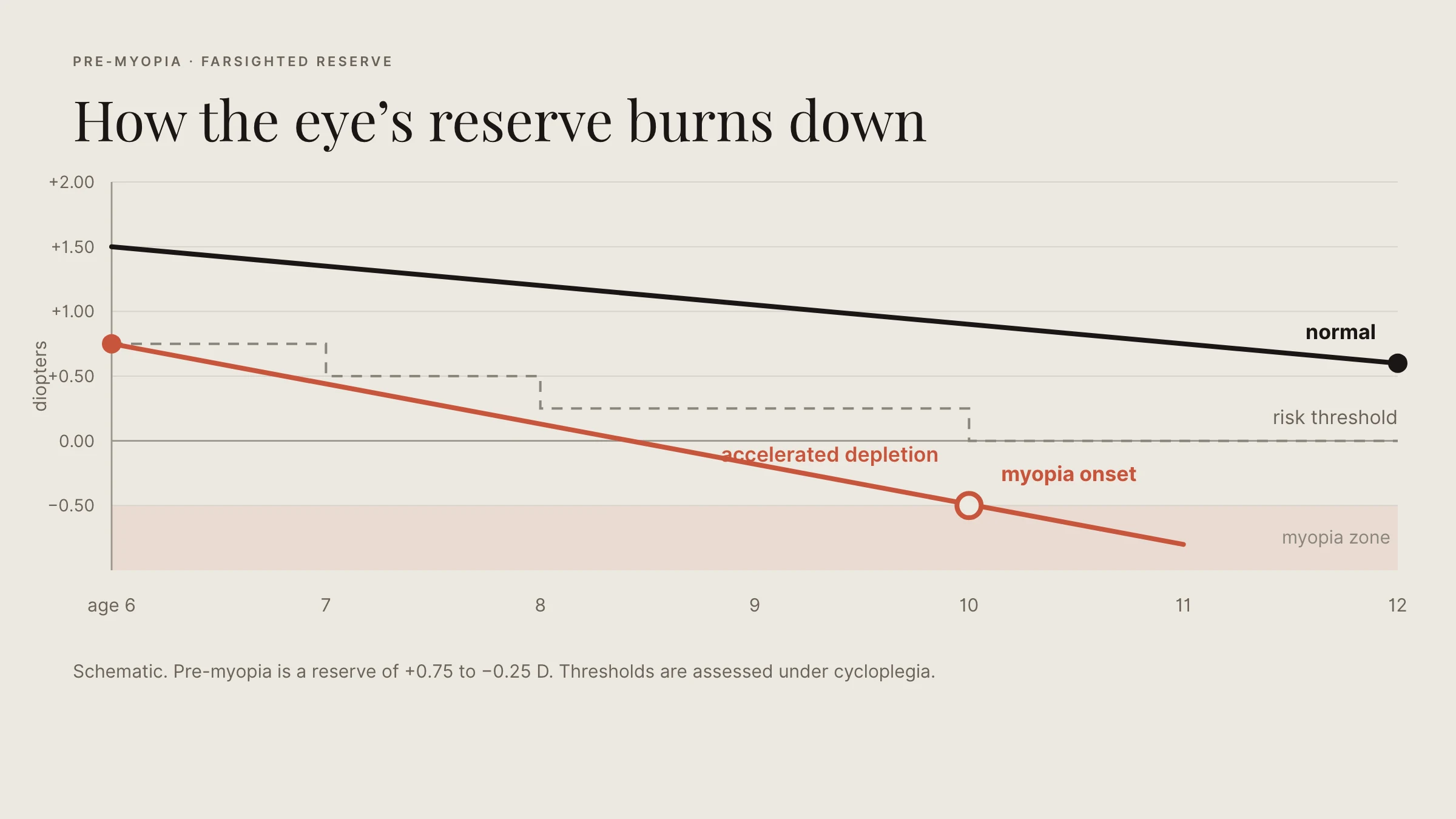
While the reserve follows the upper curve, there is time. The lower one crosses the thresholds and turns negative by age ten.
One detail matters enormously: the reserve must be measured under cycloplegia — with drops that relax the focusing muscle. Without them, accommodative tone masks the true picture, and a child with a depleted reserve can look perfectly normal.
The second marker is eye length, specifically the axial length. Before myopia starts, the eye visibly accelerates: research shows growth of 0.2 to 0.43 mm in the year preceding onset. The figure even predicts timing — 0.43 mm per year means myopia will likely start in about a year; 0.2 mm means roughly four. Think of a speedometer: still within the legal range, but the needle is climbing.
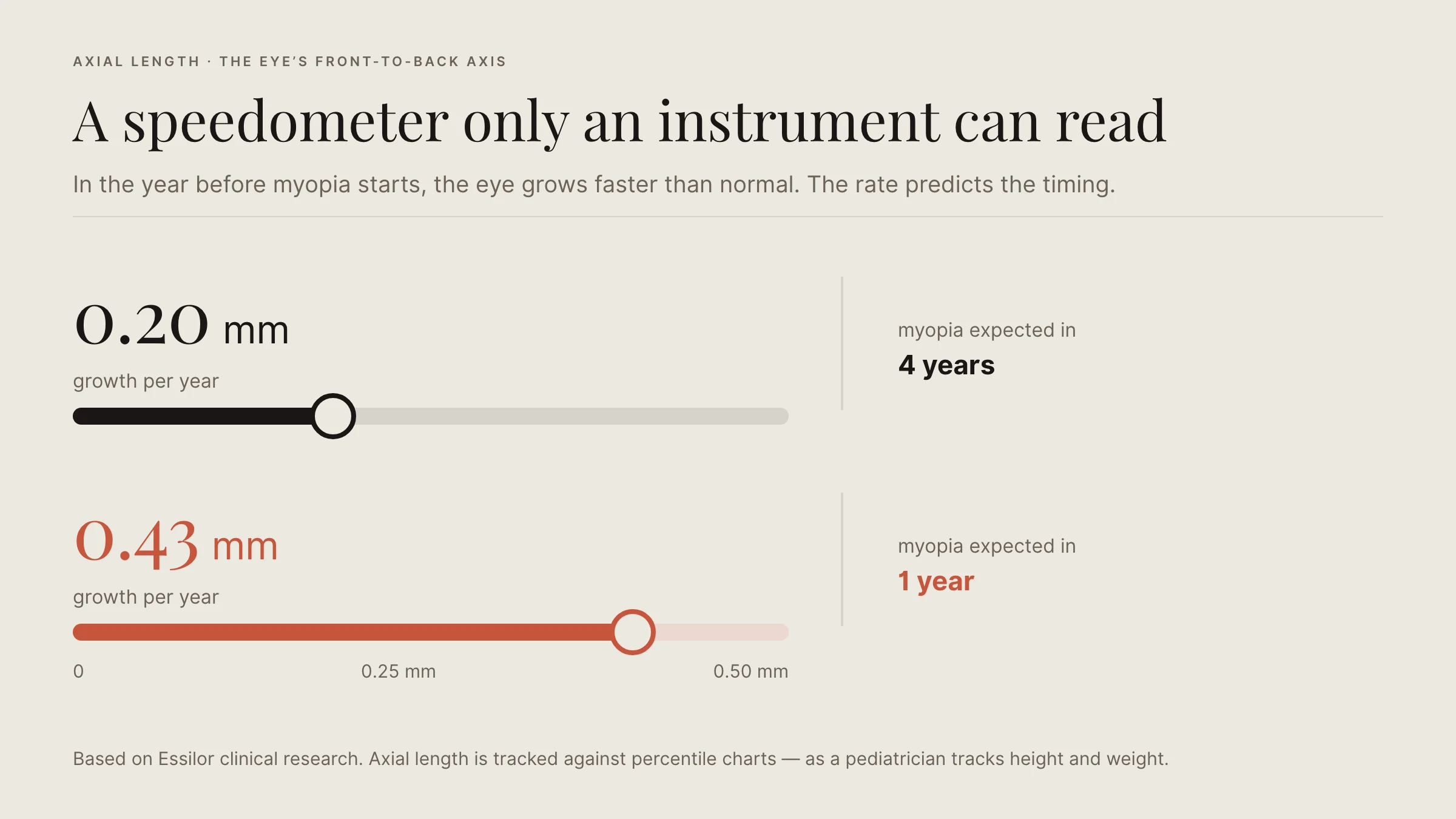
The rate of eye growth predicts not only that myopia will start, but when.
Why One Year of Delay Is So Much
Here is the central number of this article. According to Essilor clinical data, delaying the onset of myopia by a single year can reduce its final degree by 0.75 diopters or more. In effect, that is equivalent to two or three years of controlling myopia that has already begun.
The logic is straightforward: myopia progresses fastest in the first years after onset, while the eye is growing most actively. The later the start, the shorter that active phase before natural stabilization — and the smaller the final prescription a person carries for life.
In this arithmetic, prevention always beats treatment. The only question is recognizing the moment to act.
A Checklist for Parents
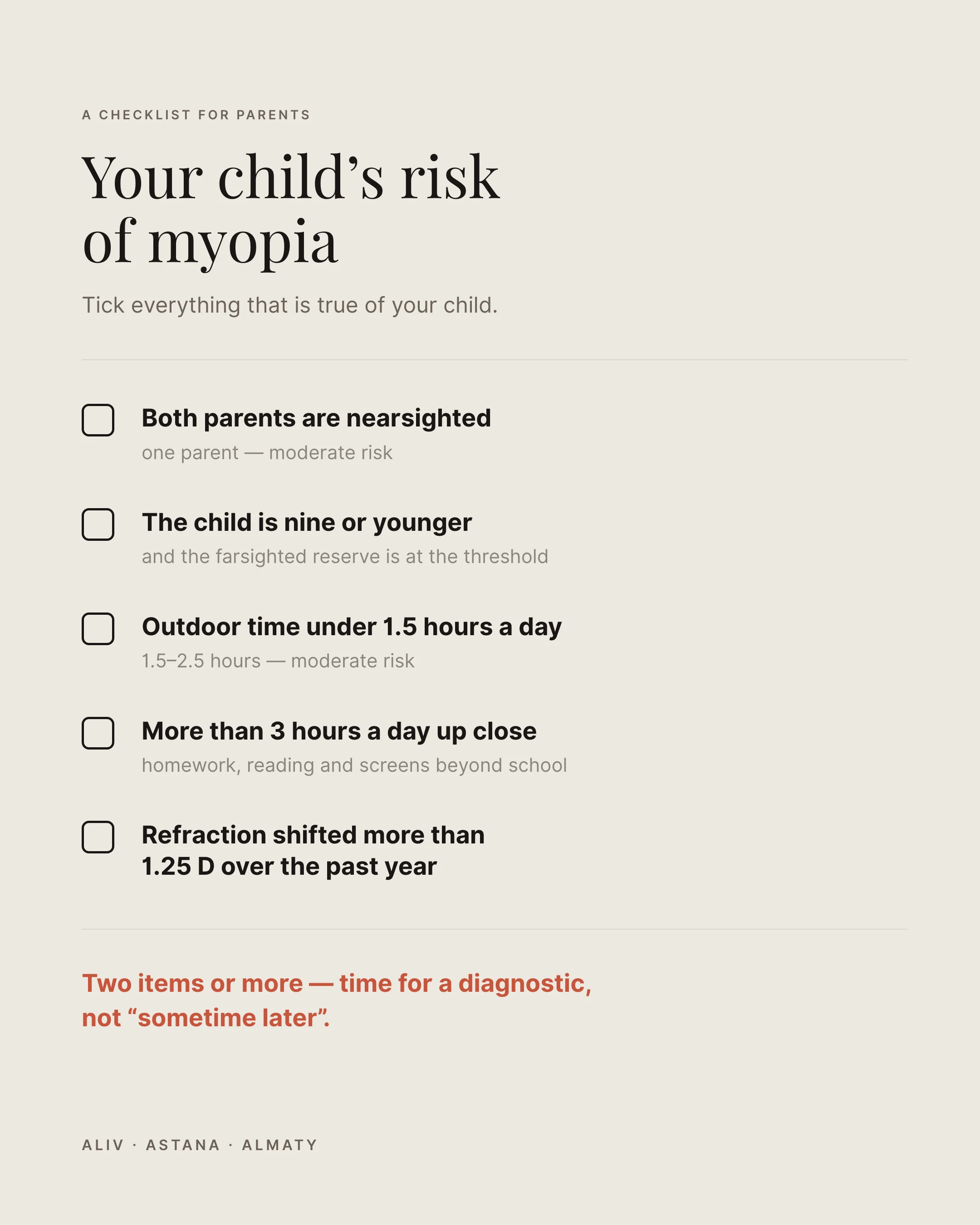
Assess risk using the same factors ophthalmologists use. Risk is considered high if:
- both parents are nearsighted (one parent means moderate risk);
- the child is nine or younger and the farsighted reserve already sits at the thresholds above;
- outdoor time is under 1.5 hours a day (1.5–2.5 hours is moderate; over 2.5 is low risk);
- near work — homework, reading, clubs, screens — exceeds three hours a day beyond school time;
- refraction has shifted more than 1.25 D over the past year (0.50–1.25 D is moderate).
Two or more matches is not a verdict. It is a reason to book a full diagnostic — this season, not someday.
Two Tools That Have Always Worked
Until recently, clinicians had exactly two strategies with proven efficacy against myopia onset.
First: outdoors, two to three hours a day. This is not about sport, or even about looking into the distance. It is about light. Outdoor illuminance exceeds 10,000 lux even on an overcast day, while an indoor room delivers 300 to 500. Bright light stimulates dopamine release in the retina, and dopamine is a natural brake on eyeball growth. A winter walk works on vision just as well as a summer one.
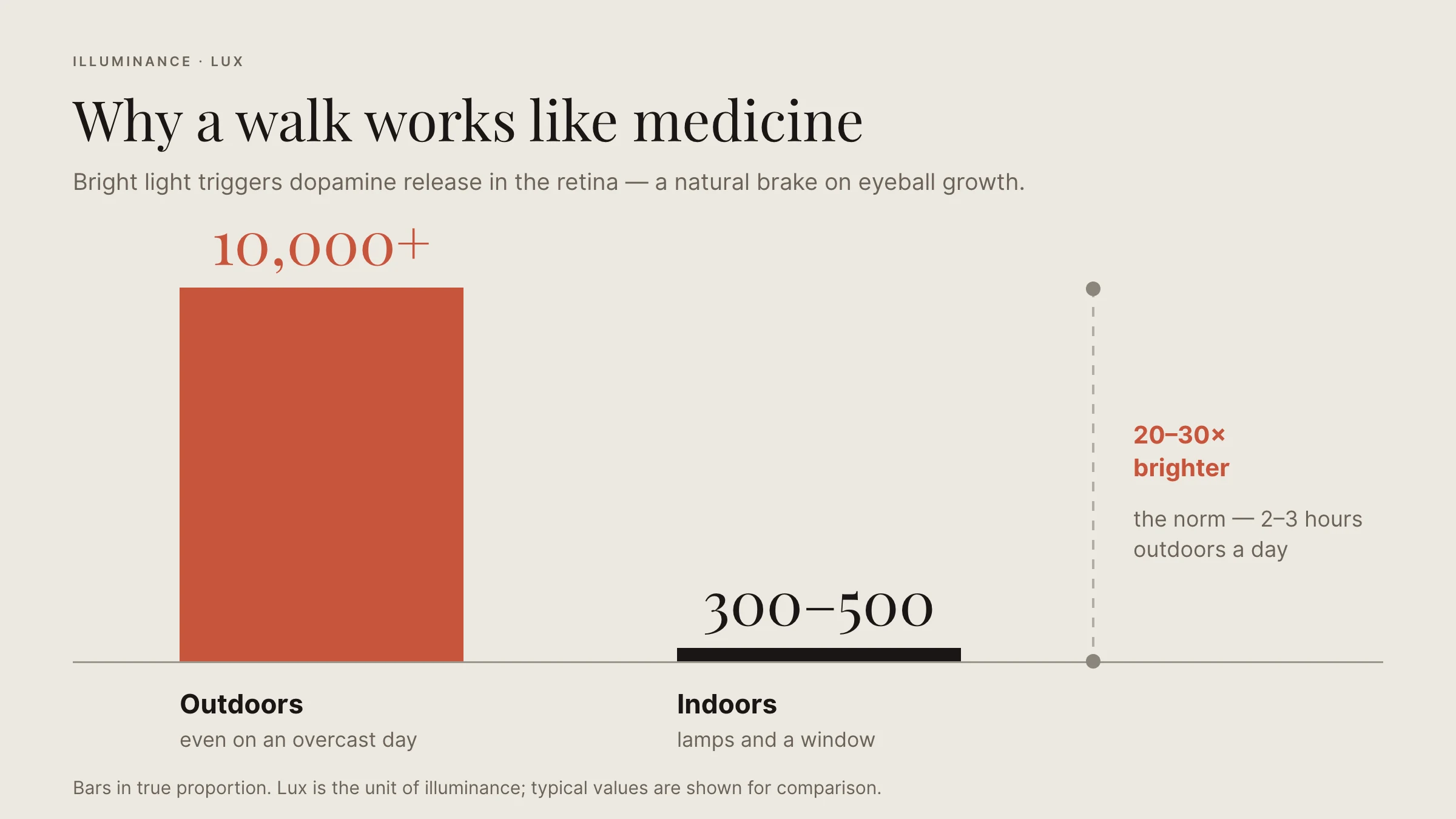
The gap between outdoors and indoors is not twofold — it is twenty to thirtyfold.
Second: less sustained close work, particularly outside school hours. School cannot be cancelled; three hours of mobile games afterward can. Practical rules: keep books and screens at least 30–40 cm away, and every 20 minutes of near work, pause for 20 seconds to look into the distance — out the window is enough.
Both strategies are free and non-negotiable. But now a third tool has joined them.
The Third Tool: Lenses That "Correct Nothing"
Essilor Stellest plano looks like an ordinary clear spectacle lens. Its power is zero: the central zone corrects nothing, because there is nothing to correct — the child sees perfectly.
All the work happens around that center. Distributed across the lens surface are 1,021 aspherical microlenses arranged in 11 concentric rings — a technology called H.A.L.T. Together they create a volume of defocused light in front of the retina: an optical signal the eye reads as an instruction to grow more slowly. In effect, a speed limiter is built into a transparent lens.
It is the same technology found in standard Stellest lenses, used worldwide for several years to control established myopia. The difference is singular: the plano version is designed for children who do not yet have myopia — only pre-myopia and elevated risk.
What the Research Shows
Skepticism toward "glasses without a prescription" is fair, so let's turn to the data.
The foundation is a randomized controlled trial of 108 children aged 6.0 to 9.9 years — among the first published studies devoted specifically to optical correction for children with pre-myopia. The finding: worn more than 30 hours per week, Stellest plano lenses slow axial elongation, the very acceleration described above.
Real-world data supports this: after one year of wear, 88% of at-risk children showed slower eye growth than peers with normal refraction. An eye that should have been accelerating toward myopia returned to a healthy pace.
One nuance is essential — the effect is dose-dependent. The more hours a child wears the lenses, the stronger the slowdown. Thirty hours a week means the format of "put them on in the morning, take them off at bedtime": school, home, outdoors. Glasses reserved for homework will not deliver. Glasses for living will.
How It Works in Practice
Stellest plano is a medical prescription, not a shelf product. The path looks like this.
Diagnosis. The ophthalmologist examines the child and measures refraction under cycloplegia — the only way pre-myopia surfaces. Risk factors are assessed: heredity, daily routine, the past year's trajectory. Axial length is tracked against percentile charts, much as a pediatrician tracks height and weight, but for the eye. Cycloplegia and axial biometry belong to an ophthalmology clinic: at ALIV salons we test visual acuity and take a refraction reading on an autorefractometer — enough to catch the warning sign and refer the child on in time.
Frame selection. Here the frame is physics, not styling. The microlenses only work when the rings sit directly opposite the pupil center. So the frame must not be wider than the child's face, narrow "adult" models are unsuitable, and the optician marks centration separately for each eye. A poor fit consumes the benefit of expensive technology — this is the part of the work ALIV never leaves to chance.
Follow-up every six months. Repeat refraction, progression review, fit check — children grow, and frames need adjusting. It is at these visits that the essential question is answered: did prevention work?
Questions Parents Ask
"Aren't zero-power glasses a placebo?" No. The mechanism is not central correction — there isn't any — but the peripheral optics of the microlenses. The effect is measured objectively, in millimeters of eye growth, not in impressions.
"Couldn't we just spend more time outdoors?" Outdoor time is mandatory; it is the foundation the lenses do not replace. But when risk is high, the foundation alone may not suffice, and the lenses act as an amplifier working every hour the glasses are on.
"What if myopia has already started?" Then the scenario changes: Stellest with prescription power, correcting vision and slowing progression at once. Essilor's published data indicate such lenses slow myopia progression by roughly two-thirds with full-time wear. Prevention comes before onset; control comes after. Missing the second is not an option — but the first is always the better deal.
"My child won't wear them." They will, if the frame is comfortable and chosen by them, and if the reasoning is put in their language: this is insurance against thick lenses later. In our experience, the question resolves within the first two weeks of habit.
"From what age is Stellest plano prescribed?" The published trial enrolled children aged 6.0 to 9.9 — that is the main age corridor. But age alone does not decide: the ophthalmologist does, based on the diagnostic — farsighted reserve, the past year's trajectory, heredity and daily routine.
"How does plano differ from standard Stellest?" The technology is identical — H.A.L.T., 1,021 microlenses in 11 concentric rings. The difference is the central zone: in the plano version its power is zero, because there is nothing to correct yet. Standard Stellest carries the child's prescription and slows progression at the same time.
"Where in Kazakhstan can we get them?" The prescription is written by an ophthalmologist after a cycloplegic diagnostic — that happens at a clinic, not an optician's. Making and fitting the pair is ALIV's part, at our salons in Astana and Almaty: frame selection with centration marked separately for each eye, and a fit check every six months. What a children's pair includes and what it costs is on the children's glasses page; vision checks can be booked here.
What to Do Now
Think back to your child's last full eye exam with dilating drops. If it was over a year ago — or never — book one. Add up their outdoor hours over a week and run the checklist above. If two or more items match, come in for a vision check at ALIV: we will test visual acuity, take an autorefractometer reading and go through the risk factors with you. And we will tell you honestly whether it is time to see an ophthalmologist for a cycloplegic measurement — or whether walks and routine are still enough.
Myopia has stopped being a lottery in which parents can only wait for the result. For the first time there is a tool that allows intervention before a child ever needs their first real pair of glasses. And the sooner you know your child's numbers, the more room you have to move.
Prepared from Essilor International clinical data (August 2025). Essilor Stellest plano lenses are prescribed by an ophthalmologist following diagnostic evaluation. ALIV operates optical salons in Astana and Almaty.
Related articles