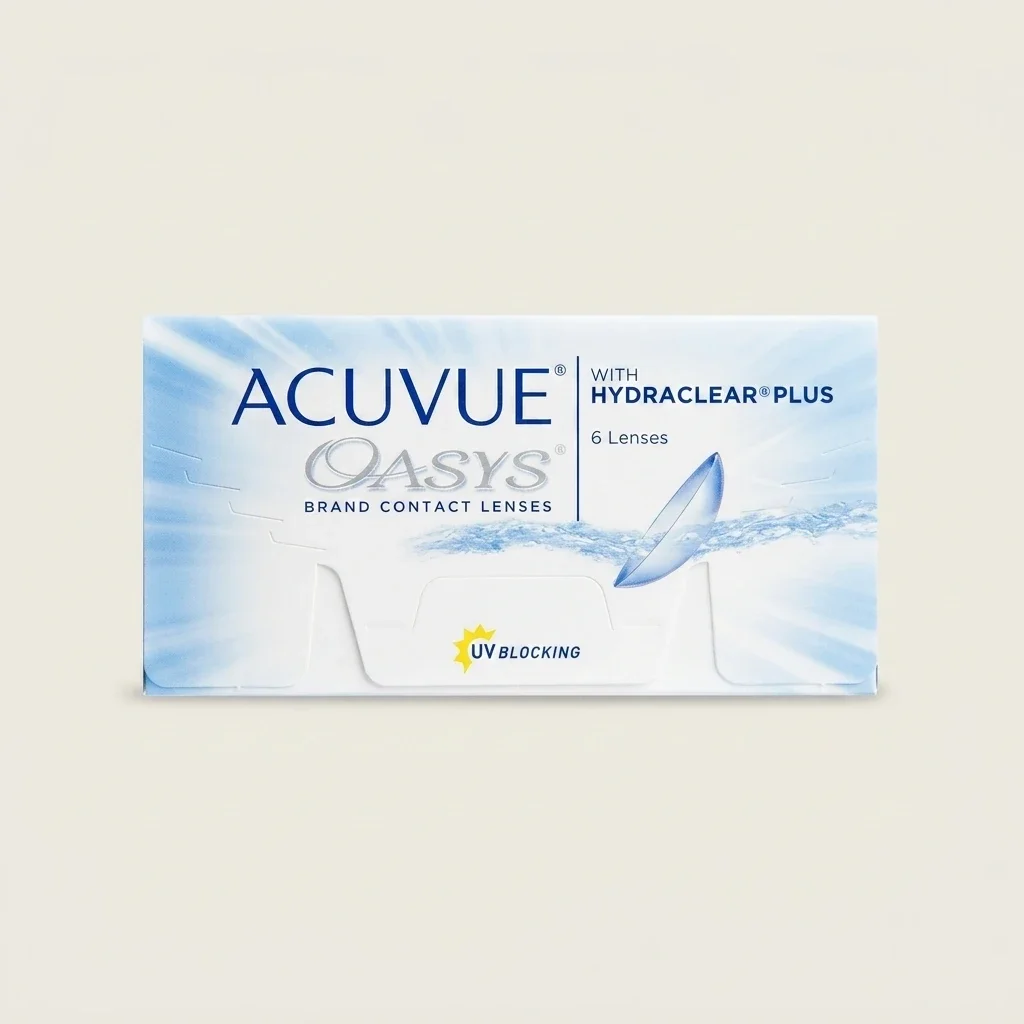
Acuvue Oasys (6 lenses)
11 970 ₸
Parameters
Fill in from your prescription or current lens box.
Select Sph for the right eye
Not sure?
Free in-store eye exam
Astana and Almaty · we will fit your parameters · Book →
Select Sph for the right eye
Express delivery in 90 minutes across Astana and Almaty
| Brand | Acuvue |
|---|---|
| Manufacturer | Johnson & Johnson |
| Wearing schedule | Biweekly |
| Lens design | Spherical |
| Material type | Silicone hydrogel |
| Material | Senofilcon A |
| Pack size | 6 шт |
| Oxygen permeability (Dk/t) | 147 Dk/t |
| Water content | 38 % |
| UV protection | Yes |
| Sphere (SPH) | -12.00 … +8.00 |
| Base curve (BC) | 8.4 … 8.8 |
Delivery
- Express in 15–90 minutes — across Almaty and Astana, 10:00 to 19:00.
- Standard delivery daily from 10:00 to 22:00, pick a convenient time slot.
- Free: from 7 000 ₸ within Almaty and Astana; from 20 000 ₸ across the rest of Kazakhstan.
- To other cities — courier or Kazpost; the exact cost is calculated at checkout.
Payment
- Kaspi.kz, bank card (Apple Pay, Visa, MasterCard) or Halyk — online.
- You can pay after delivery.
- Payment happens on the bank secure page — card details are never stored on our servers.
- Dk/t
- 147 Dk/t
- Water content
- 38 %
- UV filter
- Yes
Acuvue Oasys is a two-week silicone hydrogel lens from Johnson & Johnson in senofilcon A: oxygen transmission of Dk/t 147, 38% water content, a Class 1 UV filter and HYDRACLEAR PLUS wetting technology. A pack of 6 lenses is 12 weeks for one eye.
Description
What two-week replacement is, and who gains from it
A two-week lens lives 14 days from the moment the blister is opened, not 14 days of wear: the count runs on the calendar even if you spent a couple of days in glasses. Every two weeks you put in a fresh lens, and the protein and lipid deposits that noticeably change comfort by the end of a month never get the time to build up.
Against dailies that is a real saving: one pack of 6 lenses is 12 weeks for one eye, or roughly 42 days of wear for two. Against monthlies the gain is hygiene — the cycle is half as long at a comparable cost per day. The price of that is an evening routine: the lens has to be cleaned with solution and left overnight in a case.
| Packs | Lenses | Days of wear for two eyes |
|---|---|---|
| 1 | 6 | ≈42 |
| 2 | 12 | ≈84 |
| 4 | 24 | ≈168 |
Which is why two packs is the ordinary quarter's supply, not a marketing figure.
What Dk/t 147 means in practice
Dk/t is how much oxygen reaches the cornea through the lens, adjusted for its thickness. Acuvue Oasys measures 147 × 10⁻⁹ at −3.00 D with a centre thickness of 0.070 mm. For comparison, hydrogel lenses on the same replacement schedule sit several times lower — Acuvue 2 is 33.
In practice, high oxygen transmission means fewer reasons for redness and fatigue at the end of a long day. It is not a guarantee of comfort: dry eye, tear film quality and how the lens sits on a particular eye matter just as much, and only a specialist can assess them in person.
Why 38% water content is not a shortcoming
In hydrogel lenses oxygen travels with water, so high water content genuinely is needed there — Acuvue 2 runs at 58%. Silicone hydrogel works differently: the silicone component conducts the oxygen, and water is not required for it.
More than that, a lens holding more water gives it up to dry air more readily and can itself feel drier by evening. The 38% of senofilcon A is a deliberate balance rather than a saving: the material holds moisture together with HYDRACLEAR PLUS, which makes the surface more wettable.
When the difference shows
Oasys is most often chosen where the eye works in an unfriendly environment:
- a working day at a monitor: blink rate drops and the tear film refreshes less often;
- air conditioning in summer and the heating season in Astana — dry air for six or seven months a year;
- a long day from the office into the evening, when taking the lens out at 18:00 isn't an option;
- travel and flights, with dry cabin air.
What to buy alongside
A reusable lens needs two things: a multipurpose solution and a case. In the evening the lens is cleaned with solution and stays overnight in a case of fresh solution — topping up yesterday's is not an option.
The case is replaced every three months: a biofilm builds on its walls that rinsing does not remove. Solution is chosen for the sensitivity of the eye; if it stings on insertion, that is a reason to discuss a change with a specialist rather than to put up with it.
How to find your parameters
Ordering takes two figures: sphere (Sph), the optical power, and base curve (BC) — 8.4 or 8.8 mm on this model. Diameter is the same across the line at 14.0 mm, so there is nothing to choose there.
Both are on a current contact lens prescription. A spectacle prescription will not do: the distance from lens to eye differs, and at higher powers the conversion is noticeable. With no prescription, or one older than a year, the parameters are fitted in person — free of charge at ALIV stores in Astana and Almaty.
When this model is not the one
With astigmatism that calls for cylindrical correction a spherical lens leaves things blurred — the toric version is what's needed, Acuvue Oasys for Astigmatism: same material and schedule plus on-eye stabilisation.
After forty, when reading up close gets harder, a spherical lens corrects distance only — that is where multifocal lenses come in. Both are prescribed by a specialist: fitting multifocal correction almost always involves a trial wear.
Delivery across Kazakhstan; in Astana and Almaty within 15–90 minutes.
Frequently asked questions
How long can one pair actually be worn?
Two weeks from the moment the blister is opened. The term runs on the calendar, not on the number of insertions: if you spent a couple of days in glasses, the lens still ages in its case. Stretching it because you wore it less is a poor trade — the material and its wettability are engineered for 14 days, and comfort and safety fall off after that.
Can you sleep in them?
The manufacturer permits extended wear for Acuvue Oasys, but only a specialist prescribes it in person. The decision depends on the state of the cornea and on how the eye tolerates overnight hypoxia, and it is made individually. By default the lenses come out at night. If a clinician does approve sleeping in them, they will also state how many consecutive nights.
How do they differ from Acuvue Oasys 1-Day?
Different materials and different economics. 1-Day is a daily disposable in senofilcon A with a different surface technology, thrown away every evening, with no solution or case involved. The two-week Oasys costs less per day of wear but requires an evening routine. Their optics and on-eye feel are close; the daily rhythm is not.
Will they work with astigmatism?
Only with a small one a clinician judged safe to leave uncorrected. If the prescription carries a cylinder (Cyl) and an axis (Axis), a spherical lens will not correct them and vision stays blurred. The toric version exists for exactly this — Acuvue Oasys for Astigmatism, on the same material and schedule. Which one you need is a specialist's call.
How do I find my base curve?
It is on a contact lens prescription, on the BC line. This model comes in two: 8.4 and 8.8 mm. The difference is fit — too flat and the lens shifts on blinking, too steep and it presses and lets less tear fluid move underneath. A base curve cannot be picked by feel at home; it is assessed on a slit lamp.
Do I need a prescription to buy?
We don't require one to place an order, but you enter the parameters yourself, and getting them wrong costs more than the appointment would. A contact lens is a medical device that sits on the cornea, and it is fitted to the state of the eye, not to visual acuity alone. With no prescription, or one over a year old, book the free fitting.
Pool, shower, sauna — is any of that fine?
Best avoided. Water — tap, pool and sea alike — carries microorganisms that a lens holds against the surface of the eye; the most dangerous of them, acanthamoeba, causes severe keratitis. In the shower, keeping your eyes closed under the stream is enough. For a pool use goggles, or better, take the lenses out beforehand.
Which solution suits, and how often is the case replaced?
Any multipurpose solution for soft contact lenses. The case is replaced every three months: a biofilm grows on its walls that rinsing does not remove. The solution in the case is changed in full every evening — topping up yesterday's defeats the disinfection. Once a bottle is opened the solution keeps for a limited period, stated on the pack.
How far does a 6-lens pack go?
Twelve weeks for one eye, or roughly 42 days worn in both. Two packs come to about 84 days, a quarter of daily wear. If you don't wear lenses every day the pack lasts longer by insertions but not by calendar: the two weeks from opening the blister run either way, whether the lens is on your eye or in its case.
What if they feel dry by evening?
Start with the obvious: room air, blink rate at a monitor, and whether the lens has outlived its two weeks. Rewetting drops compatible with contact lenses help. If the dryness repeats daily, that is a reason to see a specialist — the cause may lie in the tear film rather than in the lens.
How do I tell the right side out?
The lens carries a «123» marking. Rest it on a fingertip and look from the side: the correct way round the edges form an even bowl, inside out they splay slightly outwards. The marking then reads correctly rather than mirrored. An inside-out lens does no harm, but it is felt and seats less well on blinking.
What does a day of wear cost against dailies?
A pack of 6 covers about 42 days of wear for two eyes, and the cost per day is the pack price divided by that — the current figure is shown in the key facts block on this page. A daily disposable of comparable class runs roughly three times more per day, but needs no solution or case, so the difference is worth counting together with the care.
Updated: 29 July 2026
Specifications follow the manufacturer’s official datasheet.
Contact lenses are a medical device. Parameters are fitted by a specialist to the state of the eye, not to visual acuity alone. A UV filter in a lens does not replace sunglasses: the lens does not cover the eye and the surrounding tissue. The manufacturer permits extended wear, but only a specialist prescribes it.
How it compares
| Acuvue Oasys (6 lenses)This model | Acuvue Oasys for Astigmatism (6 lenses) | PremiO (6 lenses) | Acuvue 2 (6 lenses) | Biofinity (6 lenses) | |
|---|---|---|---|---|---|
| Replacement schedule | Biweekly | Biweekly | Biweekly | Biweekly | Monthly |
| Material | Senofilcon A | Silicone hydrogel | Asmofilcon A | Etafilcon A | Comfilcon A |
| Dk/t | 147 Dk/t | — | 161 Dk/t | 33 Dk/t | 160 Dk/t |
| Water content | 38 % | — | 40 % | 58 % | 48 % |
| UV filter | Yes | — | — | — | — |
| Pack price | 11 970 ₸ | 15 490 ₸ | 14 790 ₸ | 9 990 ₸ | 23 970 ₸ |
| ₸/day for two eyes | 285 ₸ | 369 ₸ | 352 ₸ | 238 ₸ | 266 ₸ |
Reviews
No reviews yet. We only ask people who actually bought the lenses — a form link goes out two weeks after delivery.
What the lenses need alongside
Reusable lenses don’t work without a solution and a case — replace the case every three months.


